
The AI Programmes: Let’s Not Panic…
Okay, deep breaths everyone! That little voice in your head panicking about robots and ai programmes stealing your lunch and your job? Totally understandable. Just the other day, hearing about my published book being eligible for a computer-generated audiobook voice did make me take a deep breath.
“Good bye long, dramatic pauses!” it seemed to whisper.
But before we all start polishing our robot hoover, let’s have a slightly calmer chat about this whole AI job takeover thing. Think of it less like a Terminator movie and more like… a really enthusiastic junior who’s a whizz with spreadsheets.
Some Things AI Programmes Can’t Do
Yes, our digital friends are getting smarter faster than a hungry squirrel on an obstacle course. They’re brilliant at the repetitive stuff, the rule-following, the ‘can you find all the blue pixels in this mountain of data?’ kind of tasks. So, some jobs that involve a lot of that might see some changes. Think of it as AI programmes taking over the chores we never really enjoyed anyway. Like data entry. Nobody really loves data entry do they?
Now, here’s the funny bit. While AI can churn out reports faster than you can say algorithm, it’s still rubbish at the stuff that makes us… well, ‘us’. Try asking an AI to tell a genuinely hilarious joke. They’re still working on their stand-up routine.
And that’s where us humans come in, with our messy, unpredictable brains. The jobs that need a sprinkle of human magic – a dash of creativity, a dollop of empathy, a whole heap of “wait, maybe we should try it this way?” – those jobs are likely to stick around.
Jobs to Stay:
- The Creative Crowd such as artists, writers who make you feel things (not just generate text), musicians who pluck at your heartstrings – AI programmes can mimic, but can it truly create from the depths of human experience?
- The Feelers and Healers: Nurses giving comfort (phew! I’m safe,) therapists lending an ear, teachers inspiring little minds – these jobs are powered by genuine human connection, something a circuit board just can’t quite nail (yet!) Imagine an AI programme trying to give a comforting hug. Slightly terrifying, isn’t it?
- Thinking Outside the Box Brigade: Scientists making breakthroughs, entrepreneurs with crazy ideas, detectives solving the truly head-scratching mysteries – these roles need that human spark of intuition and the ability to connect seemingly unrelated dots. AI is great at finding patterns, but true innovation often comes from breaking them.
- The Handy Humans: Plumbers wrestling with rogue pipes, electricians taming unruly wires, carpenters building things that don’t fall over – the real world is a messy, unpredictable place, and robots with perfect precision often struggle with the unexpected. Plus, who else are we going to call when the robot vacuum cleaner goes rogue?
- Sportspeople: No AI is ever going to win the highjump or play football.
So, instead of picturing robot overlords, maybe we can think of AI as a super-efficient, slightly humourless assistant. It can take care of the tedious bits, freeing us up to do the stuff we’re actually good at – the creative, the caring, or the “let’s try something completely bonkers” stuff that defies all logic.
The Future
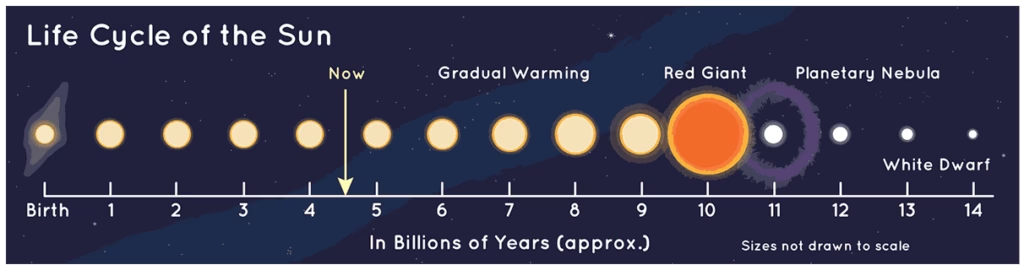
An infographic of the Sun’s lifecycle from NASA.
Life on earth is not forever. Current scientific models of star lifecycle applied to our sun, means we only have 4.6 billion years left before humans cannot live here. Progress is necessary – we need to learn how to survive. Science fiction will become science fact. Ai must be able to help with expanding our knowledge and human capabilities to face catastrophic instances, find solutions and survive. For more information on the Sun’s life cycle go to the NASA website.
Me and Ai Programmes
 Venturing into the realm of AI programmes for my audiobook, ‘Baby on Board,‘ has been quite the learning curve. It’s certainly not a simple click-and-go affair! I’ve discovered that each page demands careful attention, particularly when it comes to pronunciation, pacing, and proper nouns. I even found myself wrestling with words like ‘graffiti’ and ‘Brufen,’ which the initial AI programme rendered almost unrecognisable. To get them closer to the correct sound, I had to resort to phonetic spellings – ‘grafeatea’ and ‘Brewfen.’ While they might not be perfect, I’m hoping they’ll go unnoticed by listeners. This audiobook is truly an experiment for me.
One significant takeaway is realising what’s lost when you opt for an AI programme over a human narrator. The richness, the subtle emotional nuances – that’s an undeniable human strength. However, the cost of hiring a professional reader, along with editing and publishing, felt prohibitive. Doing it myself, I knew I’d never be entirely satisfied. So, I’m keenly observing the sales figures for this AI-narrated version.
My fascination with gadgets and technology, particularly AI programmes, has been a constant. My family often joke that my desk resembles air traffic control! This interest is what fueled my dystopian trilogy, ‘The Corinth Programme,’ which centers around an outdated robot who uncovers a secret AI programme designed to save the planet. The potential of AI is a significant theme in my writing. The idea of the sun’s eventual demise, something I learned about as a child, has always lingered in my mind.
The Future and AI
Considering the distant future and the challenges humanity might face, like the sun’s expansion, it seems likely that AI programmes, working alongside us, will play a crucial role in finding solutions. Progress, especially with such a future looming, feels inevitable.
I heard about the sun’s demise when I was about 12 years old and it has always bothered me. We all need to think about the distant future, when the sun will consume us all. Ai is likely to find a way (alongside us humans) to prevent this predicted end of civilisation, so you can’t stop progress with this waiting for us.
I believe the future of work isn’t about humans versus AI, but more likely humans plus AI. It’s about figuring out how we can team up, with the robots handling the grunt work and us humans bringing the flair, the heart, creativity, novelty and the occasional well-timed joke.
So, take a breath. The job market might do a bit of a cha-cha slide as AI beds in, but our uniquely human skills are still very much in demand. Let’s focus on nurturing those, keep learning, and maybe even teach those AI assistants a decent knock-knock joke.
The future might be a bit weird, but it doesn’t have to be more scary than it is already, AI programmes need to be here – the same as humans.
Interested in more – Jump over to my Substack account to follow me in the future. It’s simple, quick and free.


