You know how it is, you’re just clicking random links on the internet feeling bored and suddenly something really strikes you as intriguing. Down the rabbit hole I go. Will I ever learn? The next few hours are spent, watching and wondering about this my newly discovered concept of the addiction loop in fiction writing. Apparently, if I can conquer this, my books will jump off their metaphorical shelves.
In this post I share my discovery and hope it will have the same effect on you that it had on me.
So, what’s it all about? It started when I watched this video from Kallaway…
And the premise intrigued me. I cannot say I have researched the science quoted here. But it makes sense.
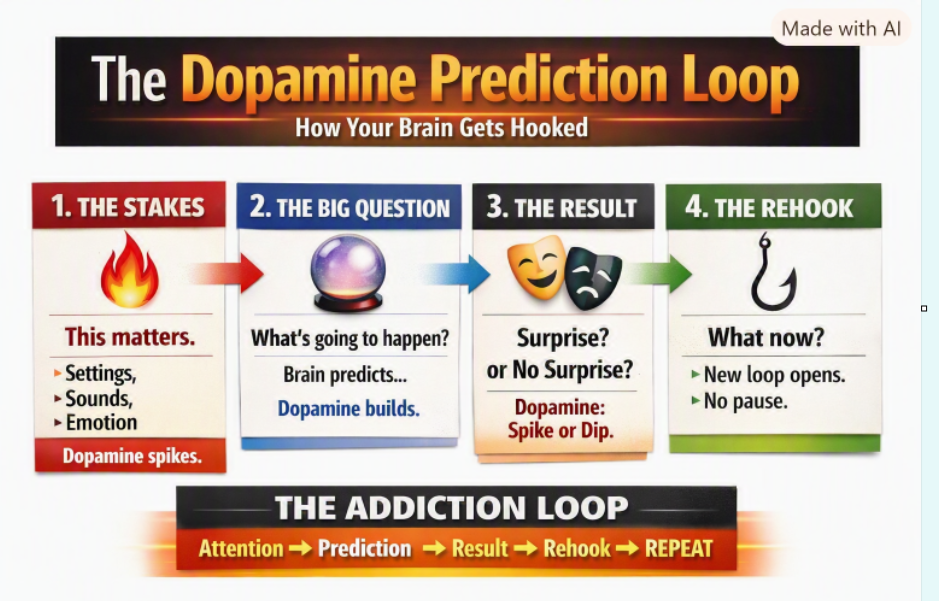
The four-part ‘addiction loop.’
Kellaway tells us is what authors must do to keep readers reading – and goes into detail of how this helps to write a page-turner. He breaks the process down into four steps:
1. STAKES — A reason to care
Before anything else, the reader needs to understand why a situation matters to the hero of the story. What is at stake? Happiness, love, death etc
Kallaway says good stakes usually contain three things:
- A character
- Something at risk
- Urgency
These stakes don’t have to massive like murder or volcanoes. They just have to matter to the character.
2. The Question
This was probably the cleverest bit of the video.
Kallaway tells us that addictive stories trigger a reader’s prediction powers – and dopamine. His simplified explanation says that dopamine is involved in anticipating and predicting reward, which equals pleasure for the reader.
He gives this example:
‘She stared at the handwriting on the envelope. She hadn’t seen it for twenty years.’
Now the readers brain is working. Whose handwriting? Why hasn’t she seen it? What happened twenty years ago?
Prediction mode switches on.
But, he warns, don’t merely make the reader curious. Give them enough information to make a prediction. The reader’s brain joins with the character. They are involved and need to find out more. Is their prediction right?
3. The Result
The reader thinks they’ve sussed it – they’d had a row 20 years ago and gone their separate ways. Then something happens which doesn’t match their prediction. But the unexpected outcome must make sense to the story. For example if its not a science fiction story, the letter cannot be from an alien. The result must be fitting to the story so the reader thinks:
Oh! Of course. I didn’t see that.
Which is why each cycle of stakes must have its own foreshadowing, so the result can be tracked back to a clue in the preceeding writing.
Kallaway calls this error the ‘prediction error,’ and it triggers the death of the dopamine in the reader. So now the reader needs another one… After all that’s what they are here for.
4. The Next Hook
Or maybe the reader will put the book down. So the author needs to work hard to bring up another question for the reader to solve, either before or just after the last one.
‘But he’d been killed twenty years ago.’
Back to step 1 a new loop… why had been killed, how etc
And that is the recurring loop throughout your manuscript.
Check Your Story
So we have simple steps. At the end of every chapter/scene check for these elements:
- What does my character want or stand to lose?
- What am I encouraging the reader to predict?
- How can the outcome differ from that prediction while still making perfect sense?
- What question is still open when the scene/chapter finishes?
Kallaway stressed the importance of the last point and how it does not have to be big drama, it can be something tiny, like:
- Why did he lie about that?
- Why hasn’t she told her daughter?
- Where did the missing £200 go?
- Why does my dog hate this nice man?
It is unfinished mental business that is working on the dopamine and keeping your reader reading!
An Aide Memoire
I asked AI to make me a graphic of the main points of Kallaways video, which I summarised from the video. Download your own, free printable PDF of the image and stick it somewhere prominent when you are next writing or editing your manuscript.
Addiction Loop
I’ve also posted this article on substack so join my tribe if you want to hear/see more like this.